Saturday, 2 February 2013

A wet walk in the Peaks…


Now, if from the title you assume this walk was under leaden skies with rain lashing down around us you would be wrong. Blue skies and sunshine were the order of the day. However, the snowmelt meant it was very wet underfoot. Not muddy, just very, very wet. Indeed there were several footpaths that looked like streams in spate rather than something to walk along. But, more of that later…

Another walk with friends we all met up by Grindleford Station (note: not in Grindleford, more Upper Padley). Deep in shade this spot was still full of snow and ice but we all managed to park without crashing into anything and once suited and booted we started to walk up towards Froggatt Edge.

The gritstone edges of the Peak District are, in fact, a series of escarpments, the sheer gritstone walls towering above the valleys below. Make the effort to get on top of them though and they afford some great views…

Anyway, back to the walk. out of Grindleford Station we took the footpath up the inaptly named Tumbling Hill. I say inaptly as a) none of us tumbled and b) I’m not sure there was ever a chance of that on such a good path. Still I’m sure there is a story behind the name. From here it was a simple case of following Hay Wood to the A625, or at least that’s what Bob led us to believe…

Tumbling Hill

Just before the road there was the small matter of a stream to cross. Unfortunately, all the snow melt had turned this small stream into something much wider and faster and tricky to cross. Cue 5 walkers all staring forlornly at the water and poking at it with walking poles as we tried to find a place to cross. Eventually a place was found and a crossing fashioned but it came at a cost as I managed to lose a pole in the water. So 5 walkers safely over the water and dry but now down 1 pole. Grrrrrr… This is the stream (and I don’t think this photo does justice to the impressive flow of water) so if anyone finds a pole here it’s mine!

"The Stream"

From here cross the road and enjoy the views as you wander along Froggatt Edge. Eyam, Sir William Hill, Stanage and the Entrance to the Hope Valley…


Various view from Froggatt Edge

However, the reverie was soon to be broken...Here we were admiring this little waterfall / fast flowing stream off Froggatt Edge and those of us with cameras were maneuvering for a better view when Bob announced that the stream was actually the path! Now, in hindsight this shouldn’t be surprising as the water was following the line of least resistance and there was a lot of water. After much wailing and gnashing of teeth Bob stepped forward and led us down as we scrambled our way down staying just above the water. Not always easy to find the path at times but somehow we made it down with both dignity and dry feet...well, dry feet anyway… But, another surprise was in store as just before we reached the road to Froggatt Bridge we came across another new stream crossing the path. This one looked rather shallower though and after confirming that with my remaining pole I quickly forded across it and the others followed (this was probably the one moment in the day I was in front and not lagging behind - must get hill fitter as it is just too flat where I live).


2 views of the new "Froggatt Falls"

After a short break we walked up to Eyam where we settled down for lunch, the cookies I had brought (recipe to appear here soon) and erudite conversation (not really…). However, as we set off again we came to the plague cottages and started to read about how whole families living there had ended up dying and how scary and depressing it must have been for the dwindling number of people left behind. Indeed, when the plague came to Eyam in 1665 the North of England had been relatively unaffected so the whole village quarantined itself so as not to spread the disease even though it meant many villagers died. See http://www.eyamplaguevillage.co.uk for more information.

However sobering this moment we had to press on with the walk and from here it was an ascent up onto Eyam Edge via Beech Hurst and thence over Bole Hill and past what appears to be an old engine house from Ladywash Mine. A fluorspar mine it closed in 1979. From here we nipped down Sir William Hill Road before taking to Eyam Moor as we headed towards Leam. Now here was some proper snow. Most of it was probably about 12 inches or so deep but I was occasionally going into it up to my knees! The other snowmelt also seemed to be running under the snow as when your feet went all the way through the snow you found some really wet slippery ground. No photos here as the camera was safely in my pocket. One slip for me (and one for Sioban) but no damage done by the soft snow. Just one wet hand from some slushy stuff - thankfully it dried out without freezing my hand off!


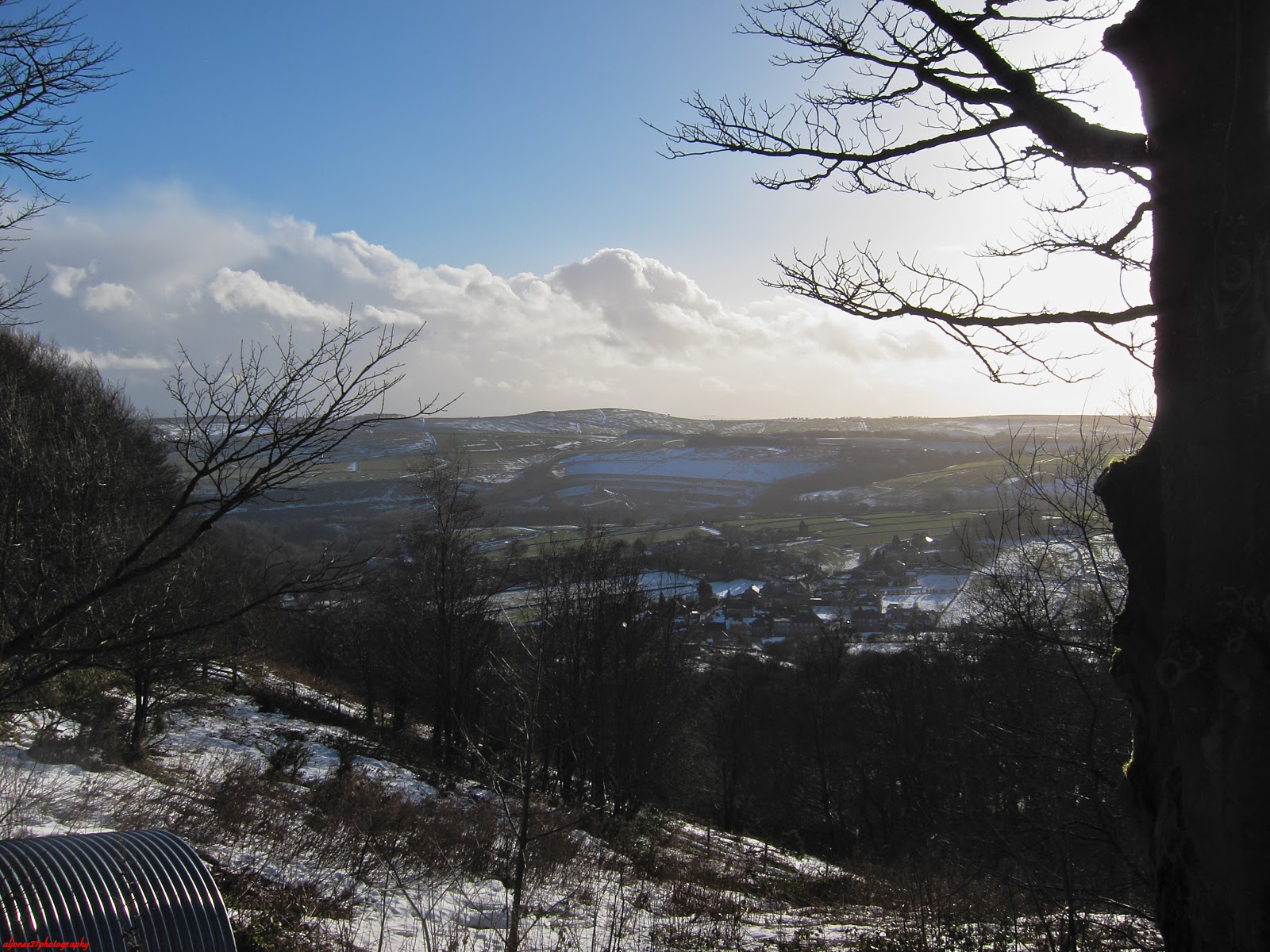
Views back towards Eyam

From here we worked our way down to Leadmill Bridge and followed the River Derwent for a while before working our way up again. Thankfully not much up left at this point as we crossed under the railway, past Kettle House and through Rough Wood before ending up back at Grindleford Station just before it got dark.

View to Higger Tor and Over Owler Tor

All in all a great day with a fantastic bunch of eccentrics friends. 11.2 miles, 3,356 feet of climb, lost one pole and very stiff the next day. Great, great day though!


Saturday, 26 January 2013

A Brightling Folly...


A walk around Brightling taking in the Follies of Mad Jack Fuller (John Fuller, 1757-1834, local Landowner, MP and supporter of the Royal Institution), a very pleasant (if cold and muddy) day with friends. The walk was led by Andrew who was our very able guide with a steady supply of both jokes and local history.

View over Blackbrooks

Starting off cold but sunny we soon warmed up as we got walking and got to grips with the mud. Well, I say got to grips, we were sliding about all day in the stuff. Parts of the walk were an absolute quagmire and I’m surprised nobody went head over heels at any point. This photo gives the merest hint of the mud that was to come. Note I’m lagging behind everyone else with a camera as usual!

Mud at Little Worge Farm

The first of the follies. The Obelisk (otherwise known as the Brightling Needle) is 65 feet high and (apparently) the second highest point in Sussex. Some claim it was built to celebrate Nelson's victory at Trafalgar (1805). Other say it was Wellington's victory over Napoleon (1815). However, with no inscription on the monument it will probably remain a mystery.

The Obelisk

Note the clouds that are starting to come in as I looked back en route to the next folly. Thankfully the heavens did not open but it did bring bad portents about the weather to come.

The Obelisk

The second folly. The observatory was built as a working observatory complete with camera obscura. However, it is now a private residence so no other views. Of note J M W Turner, yes, the Turner of “The Fighting Temeraire” fame (see Wikipedia: J.M.W.Turner) was a visitor in his younger days…

The Observatory

Onwards, this strange contraption is a covered conveyor belt (part of a gypsum operation) as we came through the woods. Also came across some interesting tree roots…

Conveyor

Tree roots

Out of the woods and it was starting to feel properly cold now. Biting wind and some fine snow visible in this shot towards Darwell Reservoir.

Darwell Reservoir

Time to shelter in the Third folly - The Tower. Many rumours about what Mad Jack was supposedly watching from here including to watch out for Napoleonic invasion, watching the local railway being built or to keep an eye on his workers restoring Bodiam Castle. However being built after Napoleon’s Waterloo but before he bought Bodiam or the railway building none of these are likely. I doubt we will ever know. Another mystery…Anyway you look at it there is a good view from the top window which Donna is looking out of here.

The Tower

Next is the strangest folly of all to my eyes. When walking through traditional country villages coming across a church is normal. Coming across a church with a pyramid is not, especially when it turns out to be a mausoleum! 25 foot high it was built in the churchyard of St Thomas à Becket, Brightling, in 1811, 23 years before his death. It used to be rumoured that he was entombed in full dress, sat at a table with chicken and wine. Sadly this proved untrue as restoration work in 1982 found him to be buried conventionally within the pyramid.

The Pyramid

The Pyramid

From here we started to loop back towards the start but there are 2 further follies. Next was The Temple. A small rotunda atop a small hill. Again rumour abounds as to Mad Jack’s use for it...the hollow base might have been used to store food and wine, a place to gamble with cronies or a romantic place to woo the ladies…

The Temple

Finally, the Sugarloaf. So called as it is a similar shape to the conical loaves sugar used to sold as it was built for a far more prosaic purpose. Having made a bet that he could see the spire of the church in Dallington Fuller returned home to discover that such a feat was not possible. In order to win the bet he had his men construct this edifice in 2 days in order to resemble to outline of the church spire. 35 foot high and 15 foot across at the base it is now hard to believe that it was converted into a 2 storey house in which people lived up until the 1930’s! The windows are now all bricked up bar one as it became a machine gun post during WW2 to defend against invasion. Certainly not a standard pill-box…

The Sugarloaf

All in all an excellent day out with friends. Now, did someone mention fun...

Wheeeeeeee.......

Friday, 18 January 2013

Cold...

... hanging around at the local RSPB reserve (Fen Drayton Lakes) yesterday hoping to see a starling murmuration which never happened. Did get a few wintery photos though...


Monday, 14 January 2013

Date and Walnut loaf (with added chocolatiness)


Confession time - I’ve changed a Mary Berry recipe! I hear sharp intakes of breath up and down the land as I type this, but, I’m baking it so what the hell. Like many (I suspect) amateur foodies I have a collection of cookbooks. Sometimes I will actually follow the recipe, but, more often than not I will go fiddling with it in some way. In other words I use them for ideas and inspiration.

This bake started off as the Date and Chocolate Loaf in the Mary Berry Baking Bible (ISBN 978-1-846-07785-2) but I decided to substitute Brazil nuts for Walnuts (well date and walnut is a classic combination) as well as adding some extra demerara sugar to the mix for a bit more toffee richness.

Anyway - how to make it. Stone and chop the dates and then place them in a bowl with the boiling water and leave them to soak. While they are soaking break up the chocolate and melt this gently in a ban marie along with the butter.

Next break up the walnuts - easiest way I’ve found to do this is to put them in some strong foil and just give them a quick bashing with a rolling pin. Keep a small amount back to sprinkle on top of the cake.

Now (once your chocolate has all melted) it’s time to bring stuff together. In a bowl mix together the flour, sugar, baking powder and bicarb. Beat the egg into the milk and then stir this into the dry ingredients well. Continue mixing while adding the nuts, dates (and the water they soaked in) and chocolate/butter mix.

Once well mixed pour it into a lined 2lb loaf tin and then sprinkle the top with the left over nuts and plenty of demerara sugar. Place in a pre-heated oven at 180C for about an hour and 10 minutes in my oven. Once a skewer comes out clean remove from oven and allow to cool for about 10 minutes before turning out onto a rack.


Ingredients:
150 grams stoned dates
150 mls boiling water
150 gram plain chocolate (use a good one 70% + cocoa solids)
40 grams butter
150 grams walnuts
225 grams plain flour
40 grams caster sugar
10 grams demerara sugar (plus extra for sprinkling)
1 teaspoon baking powder
1 teaspoon bicarbonate of soda
1 large egg
150 mls milk


My only other comment (word of caution?) is that with all the demerera sprinkled over it the top gets quite a crunchy glaze. Tastes lovely when eaten but makes it quite hard to slice as the top breaks up a bit under the knife. Doesn't necessarily look so pretty when sliced. However, it was unanimously declared delicious and 10 hungry walkers can't all be wrong can they?

Finally, I'm going to enter this for Alphabakes. Hosted this month by Caroline of Caroline Makes... (as well as Ros The more than occasional baker) the letter is D. D for Dates.


Saturday, 22 December 2012

Thanks!

Just to say thank you to those of you who have started to follow / read this blog.

It's been a very busy year on the non-walking/cooking front leaving me with rather less time than I thought I would have had for this.

However, I should now have more time which means that there will be plenty of things to come next year. Enjoy Christmas and New Year and I'll see you in January!


Sunday, 9 December 2012

A Penshurst Loop

Just a quick trip report this one. I've been meaning to do it for a few weeks but stuff has just kept getting in the way.

A good walk with some friends around a rather muddy Kent. Loop from Penshurst via Chiddingstone. Pictures below:


Lovely crisp winters day..

Swans on a pond

Chiddingstone Church

Autumnal tree

Oast House

The flock...

The Chidingstone itself

Old pill box

Ramshakle building

Peahen

Penshurst Place

Inside Penshurst Church


Friday, 30 November 2012

Duck with an Orange and Juniper Sauce

Duck and orange - a classic combination...So, why mess about with it?

Well, I don't know about you, but, personally I find that an orange sauce by itself can be a bit too sweet and the juniper just cuts through the sweetness without overpowering the duck. I'd love to show you a picture but for some reason I never took one...Sorry.


First up - the duck. I roasted off a couple of duck breasts. Just for the record I only had one hot with the sauce, the other was allowed to cool and made a wonderful sandwich the next day...

Anyway, take the breasts, score the skin a few times and then place skin side down in a medium-hot frying pan. Allow them to cook for 5 minutes so the skin is nicely coloured and then turn them over just long enough to seal the other side of the breasts. Take them out of the pan and place on a roasting tray and put in the oven 180C for 18 minutes for well done. I know some people say you can have duck rare but I prefer mine well done and these came out with just a hint of pink and very juicy still. Allow 10 minutes to rest before serving.


Secondly - the sauce. This will do enough for 2.  Take a pan and melt a decent sized knob of butter and then mix in some sugar. Add to this a generous slug of Triple-Sec, the juice of a large orange, half a dozen crushed juniper berries and 1 egg yolk (as you may have guessed - if I'm not baking I don't tend to measure much). Mix together well and keep mixing whilst the sauce reduces. When it has reached the right consistency (think runny honey) it's ready to use (just remember to pass it through a sieve in order to separate out the berries along with any bits of orange, pips etc...).

Enjoy!